

You know this ritual. You draft the payment reminder and read it back, and it sounds too harsh. So you cut the firm line and add a "hope you're well." The ask turns into a question. By the fourth rewrite, the email is so polite it apologizes for existing. You send it and hope. A week later you are back in the drafts folder.
If your invoice is already late, skip straight to the scripts. If you can spare a few minutes, start here, because the softened email is a symptom of something bigger.
This is not a manners problem. It is a survival problem. The 2026 QuickBooks late-payments report found that 59% of small businesses were carrying invoices at least 30 days overdue, up from 47% a year earlier. The trend is the story: it got worse in a single year.
Fair warning before we go on: we make Praxivara, an AI assistant that includes an invoice-chasing agent, so we have a stake in this topic. The scripts below work whether or not you ever touch our product.
The margin for error is thin. In the same report, 39% of owners said a single late payment made it hard to cover payroll or bills in the past year. For 27%, a missed payment under $5,000 was enough.
So this article is a clock, not a pep talk.
It has eight stops, from a week before the due date to ninety days past it, and every stop gets a copy-paste email written to be sent as-is. There is one phone script, built to end with a payment date instead of a vague promise. The legal levers get plain-English treatment: when you can actually charge a late fee, and what a demand letter or a small-claims filing really buys you. There is a chapter on what to do when the client finally replies, because "the check is in the mail" needs its own playbook. And the last stop is the part nobody likes to put in writing: the honest math on when chasing costs more than the invoice is worth.
The clock starts earlier than you might expect, a full week before the invoice is due. That is on purpose, and the reason starts with why clients go quiet in the first place.
Why clients actually pay late (it's usually not what you think)
Most late payment is machinery, not malice. Your invoice is your mortgage payment. To the client's accounts-payable process, it is one line item in a long queue. The person who hired you and loved the work is often not the person who pays you, and those two people may not have spoken in weeks. Nobody over there is thinking about you at all, and that is both the insult and the good news. The silence you are reading as a verdict is usually a slow machine doing what slow machines do.
There are five real reasons clients pay late. In rough order of how often each shows up:
- They forgot. The invoice landed, got a mental "later," and sank. Nothing is wrong and nobody decided anything.
- It's stuck in their process. Approval chains and monthly payment runs, or a PO number that doesn't match. Bigger clients pay when the machine pays, not when your invoice says. Net-30 on your terms means little to an AP team that cuts checks on the 25th.
- They think something is wrong. With the invoice or with the work. Rather than say so, they sit on it and hope the awkwardness fixes itself.
- They want to pay and can't. Their own client is late, and your bill is queued behind their rent and their payroll.
- They won't pay. Real, but far rarer than your worst-case brain insists at 2 a.m.
Only the last one is a villain. The other four are a business being a business.
The numbers back the machinery story. Xero Small Business Insights tracks anonymized ledger data from more than 32,000 US businesses. That is real bookkeeping data, not a survey. It shows the average US small-business invoice took 28.8 days to get paid in the March 2026 quarter, up from 28.3 the quarter before. The same ledgers show invoices ran an average of 9.0 days past due, up from 8.4. And that 9-day figure is averaged across every invoice, including all the ones paid on time. Lateness is not the exception. It is the baseline.
It is not a small-company quirk either. Atradius's 2025 Payment Practices Barometer found 43% of US B2B credit sales overdue. That covers B2B invoices generally, at firms of every size. Getting paid late is simply how business billing runs right now, which means your late client is probably not making a statement about you.
Waiting politely is not neutral. Silence teaches the client that your payment terms are optional, and every week you wait, your odds of ever collecting get worse. So the answer to "when should I start chasing?" is: before the invoice is late.
From your side of the wall, all five reasons look identical, and that is the problem this article is built around. A lost invoice, a stalled approval, a quiet dispute, and a client dodging you all produce the same silence in your inbox. You cannot diagnose it from a distance. So the chase has to work on all five at once: messages that surface the real reason early, sent on a fixed schedule that does not depend on your mood or your nerve.
That system is a clock.
The Escalation Clock: eight stops from a week early to ninety days late
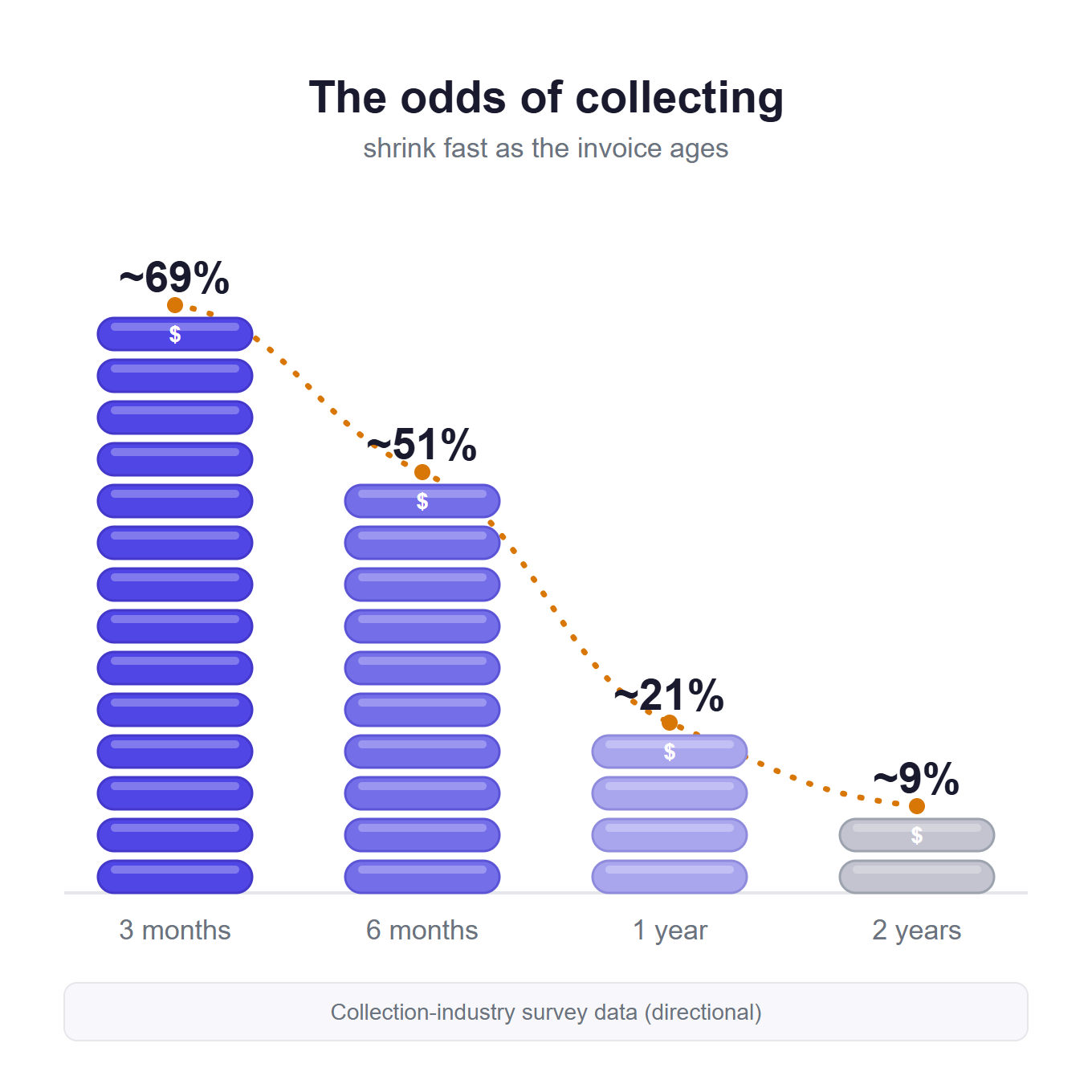
An unpaid invoice rots on a schedule. Collection-industry survey data puts the odds of ever collecting a past-due B2B account at roughly 69% when it is three months old. At six months, about half. At a year, about one in five. Be honest about where those numbers come from: an undated member survey by the Commercial Collection Agencies of America, a trade group that benefits when you feel urgency. Treat the exact figures as directional. The direction is enough. Every collection curve anyone has drawn slopes the same way, and none of them slope up.
That decay is why this article runs on a clock instead of a mood. The Escalation Clock is eight stops, from seven days before the due date to ninety days past it. Every stop has three parts. The message: what you send, word for word. The lever: what new pressure becomes fair to use at that age. The exit: the signal that means jump ahead, or stop chasing entirely. The first stop fires before anything is even late, and that is deliberate. A client who got a calm heads-up last week reads your day-3 nudge as process. A client who hears nothing for a month and then gets a stiff email reads it as a grudge.
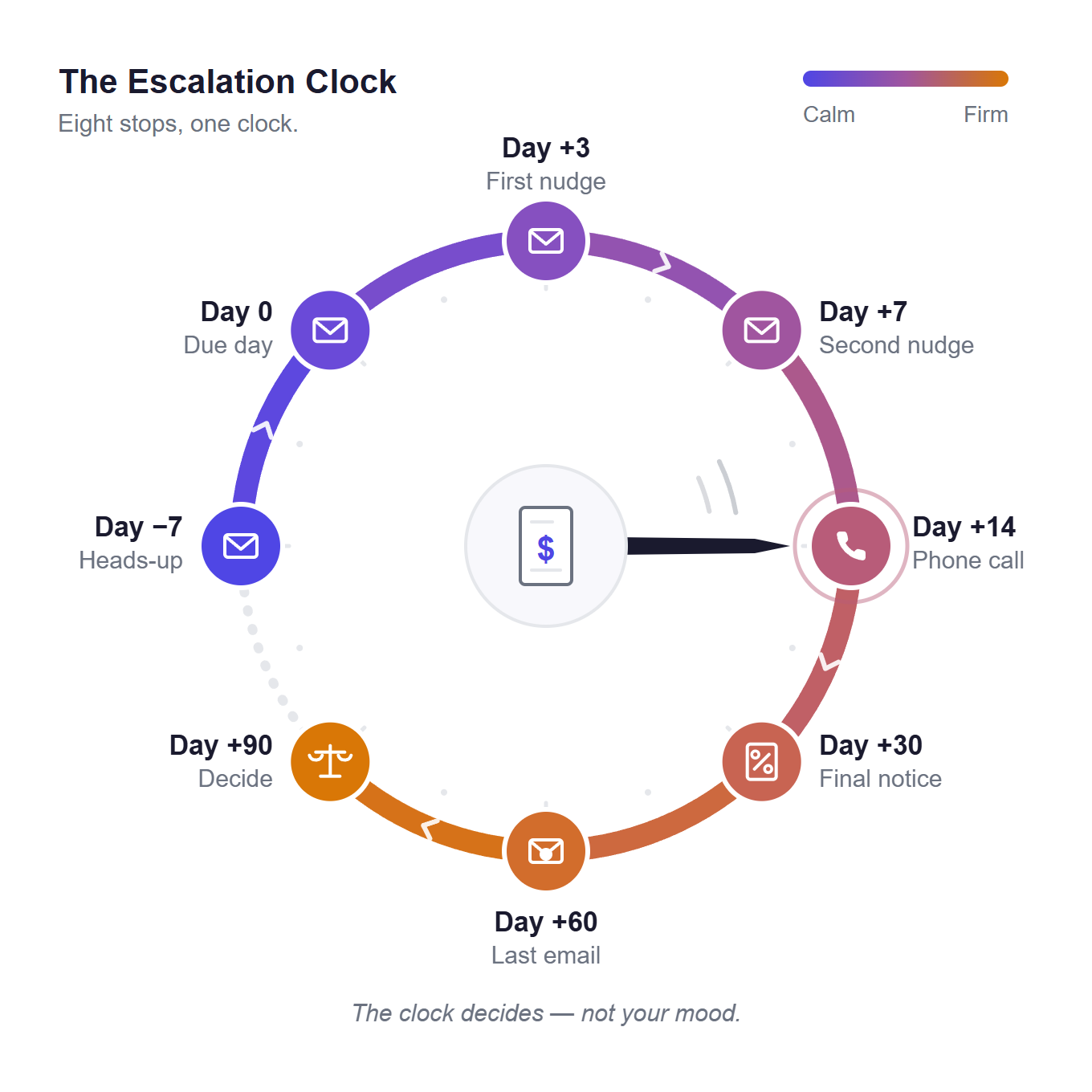
The rule that makes the clock work: you never escalate because you are angry. You escalate because the clock says so. A schedule takes the emotion out of it for both sides. The client is not being singled out, and you are not lying awake working up the nerve to send the next email. This is simply what your company does when an invoice ages.
The whole clock, at a glance.
| Stop | Day | Send | New lever |
|---|---|---|---|
| 1. Heads-up | Day −7 | Courtesy email | None |
| 2. Due day | Day 0 | Factual note | None |
| 3. First nudge | Day +3 | Diagnostic email | The question |
| 4. Second nudge | Day +7 | Date request | Inside advocate |
| 5. Phone call | Day +14 | Firm email, call | Your voice |
| 6. Final notice | Day +30 | Final notice | Late-fee clause |
| 7. Last email | Day +60 | Dated next step | Demand letter |
| 8. Decide | Day +90 | Nothing | The math |
Most invoices never see the bottom half of that table. Atradius' 2024 US payment-practices survey found overdue B2B invoices turned into cash an average of 20 days past due. Note the base: that average counts late invoices only, and it puts the typical resolution right around stop five. The early stops handle the normal case. The late stops exist for the invoice that refuses to resolve, so that when day 30 arrives you already know what happens next instead of inventing a policy while furious.
The clock is also allowed to jump, and the jump conditions are spelled out at each stop. A second broken payment promise skips you straight to day 30, because a promise is only worth honoring while breaking it costs something. Total silence plus a bounced email, or a client company that has quietly dissolved, skips you to day 60; there is nobody left to nudge politely. And any real reply pulls you off the timeline entirely, into the off-ramps covered later in this article. A client who is talking to you gets a conversation, not a countdown.
One warning before the stop-by-stop detail. This sequence hands off to software cleanly, and the smart version of that hand-off is the half-automation move, where the machine drafts and schedules while you keep the sign-off. But run the clock by hand at least once first, on a real overdue invoice. You cannot supervise a process you have never run yourself, and you will not recognize a limp chase email until you have written a few good ones.
Stops 1 and 2: the week before, and the day it's due
The cheapest chase email is the one you send before anything is late. A short heads-up about a week out does two jobs at once. It makes every later reminder read as a process the client is already inside, not a mood you woke up in. And it flushes out "we never received it" while that is still a five-second fix, instead of a surprise you dig up at day 40.
Almost nobody sends this email, and that is a large part of why it works.
There is a second payoff. Many companies pay bills in batches, on fixed dates, and their calendar does not care about yours. If their accounts team cuts checks on the 25th and your invoice is due on the 14th, you will be "late" every month, forever. Nobody will think to tell you why. One light question in the pre-due email surfaces that schedule. Now you know why last month's invoice sat, and you know what date to put on the next one.
Skip this stop if you invoice the same client every week, or if the amount is tiny. A weekly retainer client does not need a courtesy email for every invoice; it reads as noise. Save the heads-up for new clients and big invoices, plus anyone who has paid you late before.
Stop 1: the heads-up (Day −7)
What follows is the entire email: warm, and brief enough to answer from a phone. It is a courtesy, and it should read like one. No "just," and no apologizing for the ask.
Subject: Heads-up: invoice #1042 ($2,400) due Friday
Hi Dana. Invoice #1042 for $2,400 is due next Friday, June 14. Could you confirm it arrived, and let me know if your team needs anything from me to process it, like a PO number or a portal upload? Here's the payment link if it's easier to settle now: [payment link]. Thanks!
Paste this into your own template doc and swap the invoice number, amount, and date before the next one goes out.
Watch for the best possible reply: they confirm receipt and mention when their payment run goes out. Write both down. That client can skip the due-day note entirely, and you now hold a fact about their payment machinery that outlasts this invoice.
There is evidence that consistent, well-written reminders move real money, though the cleanest number comes from an interested party. The 2025 QuickBooks late-payments report found that businesses using its AI-drafted invoice reminders got paid five days faster, on average, than businesses sending standard ones. That is QuickBooks' own number for its own feature, so hold it loosely. The direction is the useful part: a reminder written once, carefully, and sent on schedule beats one written fresh each time out of irritation.
Stop 2: the due-day note (Day 0)
The due-day note is even smaller, and it is not a nudge. It is a note. Short and factual, with no pressure of any kind. Its one job is to put the payment link a single click away on the exact day the client is most likely to act. If payment lands, the clock stops and this invoice never crosses your mind again.
Subject: Invoice #1042 ($2,400) — due today
Hi Dana. Invoice #1042 for $2,400 is due today. Here's the payment link: [payment link]. If you'd like me to resend the invoice PDF, say the word.
Keep a copy wherever you draft email, so sending it takes thirty seconds on the day instead of ten minutes of wording.
Two emails, maybe ninety seconds of typing between them, both sent while everything is still fine. Most invoices end here. The rest of this article exists for the ones that do not.
Stops 3 and 4: the first two nudges (day 3 and day 7)
Three business days. That is how long any accounts-payable system needs to log an invoice it actually received, which is why the first nudge lands on day 3 and not day 10. If they cannot confirm receipt by now, something is off, and you want to know what. Remember the base rate from the clock section: the average late invoice resolves around week three. Most invoices that go late at all get paid right here, at stops 3 and 4.
These two emails are the workhorses of the entire clock.
The day-3 email is a diagnostic, not a demand. It asks the one question that saves weeks: "Was there any problem with the invoice, or anything about the work I should know about?" That question surfaces a dispute, a missing PO number, a wrong contact, or a plain "we never got it" while the fix still costs minutes. The same problem found at day 40 costs a month of silence and most of your goodwill.
The subject line does more work than the body here. Tested subject-line data points one way: generic "payment reminder" wording underperforms a subject built from the invoice number and amount, and putting your company name in the subject lifts opens. All-caps and "URGENT" styles opened at roughly 30 to 36 percent in one 2026 subject-line dataset, which is spam territory. "Quick question about invoice #1042" is legitimate for this email, and only this email, because you genuinely have a question. Reuse it on later reminders and honesty turns into a trick. Clients notice.
Subject: Quick question about invoice #1042
Hi Dana,
I'm checking on invoice #1042 for $2,400, which was due June 14. Was there any problem with the invoice, or anything about the work I should know about? If it never arrived or went to the wrong inbox, tell me and I'll resend it right away, or route it to whoever handles payments. If everything looks fine, here's the payment link: [link].
Swap in your own numbers and save this one as a template; you want it a click away, not a search away.
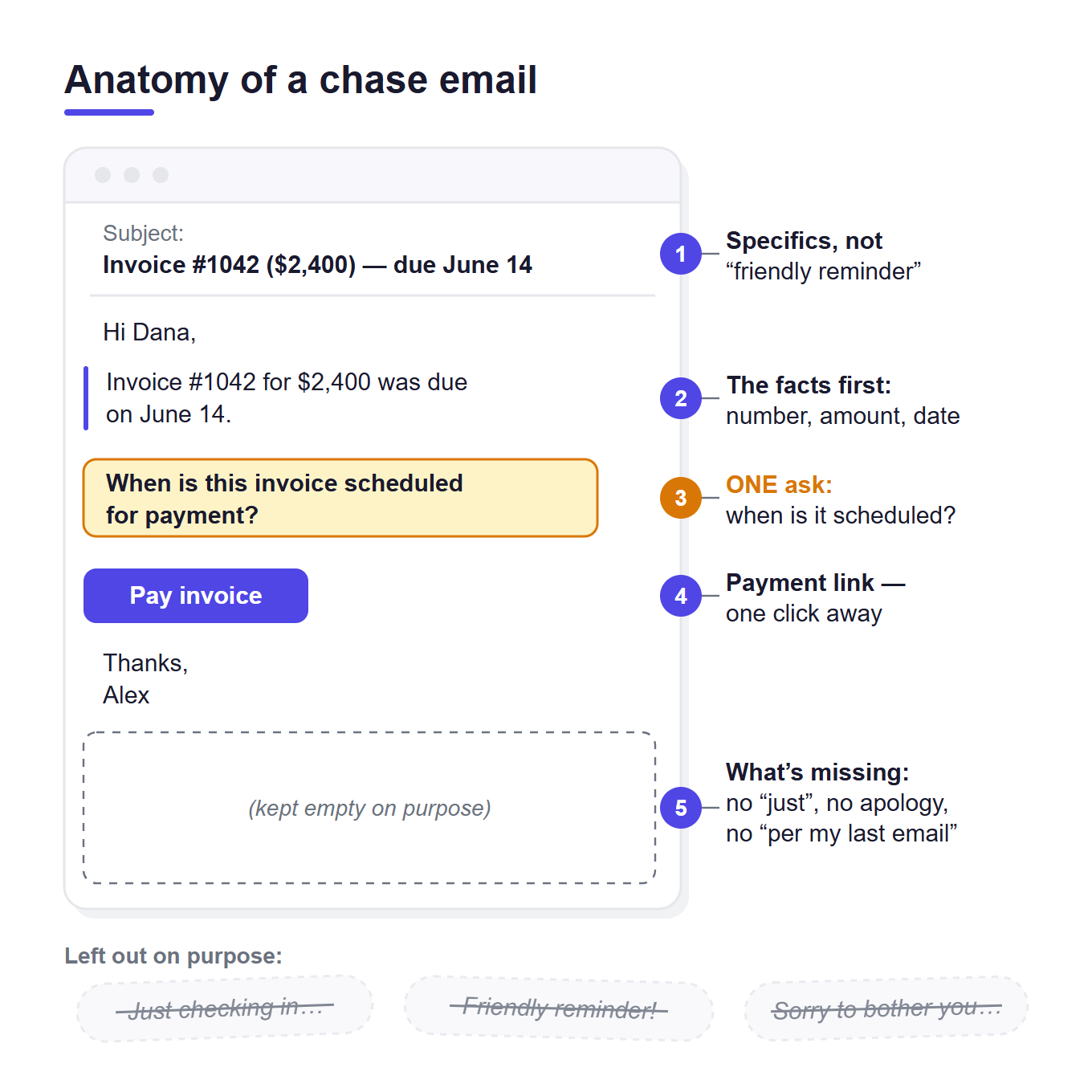
If day 3 gets silence, day 7 changes the shape: facts plus one ask. Name the invoice, the amount, and the original due date, then ask them to confirm when payment is scheduled. One ask only. Two asks split attention and get zero answers.
The anatomy is four moves. A subject carrying the number and the amount. A fact line. A single ask for a payment date, then the payment link. What is absent matters as much as what is present: no "just," no "friendly," no "per my last email," no apology. Each of those words either begs or blames, and neither gets an invoice paid.
Subject: Invoice #1042 ($2,400) — due June 14
Hi Dana,
Invoice #1042 for $2,400 was due June 14 and is now seven days past due. Could you confirm when payment is scheduled? If the payment isn't yours to send, could you help me move this forward with your accounts team? Here's the payment link: [link].
Copy this one into the same doc as the rest. Of every email in this article, this is the one you'll send most.
What if day 7 gets you a promise instead of a payment? Take it. A dated promise is progress, so the clock pauses until that date and resumes the moment it passes unpaid. The resumption is automatic, not a judgment call. Log the resume date on your calendar the day you take the promise, not the day it breaks.
Stop 5: day 14 — send one more email, then pick up the phone
A fractional consultant had a $20,000 invoice stuck at 60-plus days. A tougher email was not going to move it, and she knew it. So she went to her day-to-day contact instead and asked for help walking the invoice through the client's accounts-payable process. She documented every step in email. She mentioned the contract's late-fee clause exactly once, and offered to waive it if payment landed by a set date. The money came. She has told the story publicly, and it carries the lesson for stop 5: when written reminders stall, you change the medium, not just the tone.
At day 14, a five-minute phone call beats three more emails. Email is easy to ignore and easy to misread. A call gets a real-time answer to the one thing you actually need, which is a payment date. Most chase sequences fail because they never leave the inbox. And most guides skip this stop because calling feels confrontational. It's the reverse. A call at day 14, before anyone is angry, is the least confrontational this conversation will ever be.
Five minutes of voice also does something no email can. It turns you back into a person instead of a thread that can sit unread.
The day-14 email still gets sent, but its job changes. It sets up the call instead of replacing it. It puts the facts on record and names the day you will call. It also leaves one last low-friction way to pay before the phone rings.
Subject: Invoice #1042 from [Your Company] — 14 days past due
Hi [Name],
Invoice #1042 for $2,400 was due June 14 and is now 14 days past due. I haven't been able to pin down a payment date by email, so I'll call Thursday morning to sort this out. If it's easier to settle before then, here's the payment link: [link]. And if you're not the person who handles payments, could you connect me with whoever is before Thursday? Thanks.
[Your name]
Paste this into your own chase-template doc now; day 14 is a bad day to be drafting from a blank page.
Making the call
Call mid-morning, and keep your voice calm and slow. Never open with fees or lawyers. The diagnostic question still goes first, because even now the invoice may be stuck on something fixable, and you want to hear about it before you push. The framing that carries the rest is borrowed from professional collection calls: the business is the bad guy, and you are only its employee. You are not upset; you have a responsibility to follow up. That framing lets both sides keep face. Your contact stays a decent person with a slow accounts team. You get to press for a date without making it personal.
One more thing belongs in the script: the silence. After you ask for a date, stop talking. The pause will feel long on your end. Let it sit. The date is on the other side of it.
Opening. "Hi [Name], it's [Your name] from [Your Company]. I'm calling about invoice #1042 for $2,400, which was due June 14. Before anything else: was there any problem with the invoice, or anything about the work I should know about?"
If they stall. "I understand. This invoice is 14 days overdue and I have a responsibility to my business to follow up. I'm not looking for conflict — just a resolution."
The ask. "What date can I put down for payment?" Then stop talking until they name one.
Lock it in. "I'll note that we expect payment on the 12th, and I'll check in that afternoon if it hasn't arrived."
Keep this script open on screen while you dial; nobody on the other end can tell you're reading.
Treat whatever date they give you as currency. A first broken promise gets one grace: follow up the same day it breaks, and set one new date. A second broken promise ends this stage. No third call, no fourth reminder. Skip the clock straight to Day 30 and send the final notice.
Stop 6: day 30 — the final notice, and the late-fee question
The late-fee answer first, since it is the question everyone reaches this stop carrying. In the US, you can generally charge a late fee on a private business invoice only if the client agreed to it in advance. That means in the contract, or in payment terms they accepted before the work started. No prior agreement, no fee. The common convention runs 1% to 2% per month. The most-cited default, and the number FreshBooks puts in its own sample contract language, is 1.5% per month, which works out to 18% a year.
We are not lawyers and this is not legal advice. State rules on late fees and interest vary widely: some states cap the rate, others leave negotiated business-to-business contracts alone. Check your state's rules, or ask a lawyer, before you add a fee to anything.
Two contrasts show how bare the US ground is. UK businesses hold a statutory right to interest on late commercial payments of 8% plus the Bank of England base rate, no contract clause required; the US offers private invoices no general equivalent. Even the US government binds itself: under federal prompt-payment rules, agencies must generally pay a proper invoice within 30 days, with interest accruing automatically when they run late.
If your contract has the clause, here is how to spend it. The contract plays the bad guy, and you play the person offering a way out: "Per our agreement, a 1.5% monthly late fee applies after 30 days. I'd rather not add it — if payment lands by Friday, I'll waive it." Notice what the waiver does. It turns a penalty into a deadline, and it lets the client move fast without admitting anything went wrong. The fee was never the point.
This pattern works outside theory. Freelance journalist Wudan Yan has written publicly about invoicing late fees. The clause sat in her contracts, and she billed the fees when publications ran 30 to 40-plus days late. She recovered roughly $5,000 across three publications. One outlet refused at first, then paid the roughly $200 fee "as an exception." An editor suggested she was being unreasonable and hinted that future work was at risk. She got paid anyway.
Now the day-30 email itself.
This is the first formal message in the sequence, but nothing about the wording gets tougher. Two things change: the audience and the ending. The account owner or decision-maker gets copied in, because your day-to-day contact has had a month and the person who owns the relationship deserves to know before things get expensive. And the next step gets a name and a calendar date. Restate the paper trail in one line, so someone reading this cold can catch up in ten seconds.
Whatever consequence you name must be true. Write "this moves to a demand letter on August 1," let August 1 pass quietly, and you have taught the client that your deadlines are decoration; the clock resets to zero in their mind. A modest consequence you will actually execute beats a dramatic one you will not.
Subject: Final notice: invoice #1042 ($2,400), late fee applies after July 18
CC: [account owner or decision-maker]
Hi [name],
Invoice #1042 for $2,400 was due June 14 and is now 30 days past due. I emailed on June 17, June 21, and June 28, and we spoke by phone on July 1. Per our agreement, a 1.5% monthly late fee applies after 30 days. I'd rather not add it. If payment lands by Friday, July 18, I'll waive the fee and we're square. Here is the payment link: [link]. I've copied [account owner] so everyone is working from the same facts. Please confirm today when payment is scheduled.
Save this one in your templates folder with the dates ready to swap; future-you will be in no mood to write it fresh.
Skip the fee move entirely if your contract has no late-fee clause. Do not invent one at day 30: you probably cannot enforce a fee the client never agreed to, and bluffing burns trust you still need while the money is outstanding. Send the same final notice without the fee lines and make the day-60 step your dated consequence instead. Then fix your contract template this week, so the next late invoice ages against terms that include one.
Stops 7 and 8: day 60, day 90, and the honest math of giving up
The decay curve from the clock section is still falling at this age, and it keeps falling: by the one-year mark, collection-industry data suggests your odds are down to about one in five. Same source, same hedge: directional, not gospel. Every option below is a race against that curve.
Day 60: the last email
Stop 7 is the shortest email of the whole sequence. No warmth, no hostility. It reads like administration, because it is. You state the facts, name the next step, put a calendar date on it, and leave exactly one exit open.
Subject: Final notice: invoice #1042 before demand letter on August 15
Invoice #1042 for $2,400 was due June 14 and is now 60 days past due. Since then I've sent four reminders and received one dated promise, on July 8. It wasn't kept. On August 15 this file goes to an attorney for a formal demand letter. Payment in full by August 14 stops this here: [payment link]. This is the last email I'll send about this invoice.
Copy this into your own templates file, and only use that subject line when the date in it is real and the step behind it is actually booked.
After this email, you stop writing and start doing. Stop 8, at day 90, is not a message at all. It is a decision between four doors: a demand letter, a collections agency, small claims court, or a write-off.
Pick by math, not pride.
Door one: the demand letter
A demand letter is a formal letter stating the debt, the deadline, and the action that follows if the deadline passes. It carries far more weight on an attorney's letterhead than on yours. Practitioners who send these report the same pattern again and again: the formality alone often shakes payment loose. Until now, ignoring you has been free. A letter from a law office signals that the cheap-to-ignore phase is over, and a surprising number of clients pay soon after opening one.
Door two: collections
A collections agency chases the debt so you can go back to work. Most work on contingency: no recovery, no fee. When they do recover, they keep a significant cut of whatever comes in. They also prefer debts that are months old, not weeks, since that is when owners finally hand files over. Run the numbers before you sign anything. On a small balance, the agency's share can eat most of what returns, so the math only works for larger invoices. And know the other price going in: sending a client to collections almost always ends that relationship for good.
Door three: small claims court
Small claims court was built for exactly this problem. It handles smaller debts without a lawyer, and the filing fee is cheap next to what you are owed. Dollar limits and procedures vary by state, so check your state's limit before you decide anything.
Two warnings. First, it takes real hours: preparing paperwork, then showing up and waiting your turn in court. Second, winning a judgment is not the same as collecting one. The court hands you a piece of paper, not a check, and turning that paper into money is its own chase.
Door four: the write-off
Below a few hundred dollars, write it off. The hours you would burn pushing a $300 invoice through a demand letter and a court date are worth more billed to a client who pays. A write-off is a business decision, not a defeat.
That 2025 number covers firms of every size, well-run ones included. The year before was rougher: in Atradius' 2024 US survey, bad debts averaged 8% of all B2B credit sales. Businesses far bigger and better-staffed than yours eat this loss on purpose, every year, because chasing the last dollar costs more than the dollar.
Whichever door you pick, keep the paper trail.
Every email you sent and every promise they broke, with dates attached, is what makes a demand letter credible and a court filing possible. A clean thread of your short, factual messages set against their silence is the best exhibit you will ever file.
Hard rule: at day 60 and beyond, stop doing new work for this client. Ongoing work is the only real pressure you have left — never hand it over while they are holding your money.
The off-ramps: what to do when they actually reply
Day 9, and a reply finally lands. You know the card before you flip it. "We never received the invoice." "The person who signs checks is on vacation." "It's in our next payment run." "We're waiting on our own client to pay us." "We're mid-migration on our accounting system." Collections teams hear these lines so often that GoCardless keeps a running list of the most common late-payment excuses, and all five are on it.
The rule for the whole bingo card: each excuse can be true once. None of them is true three times.
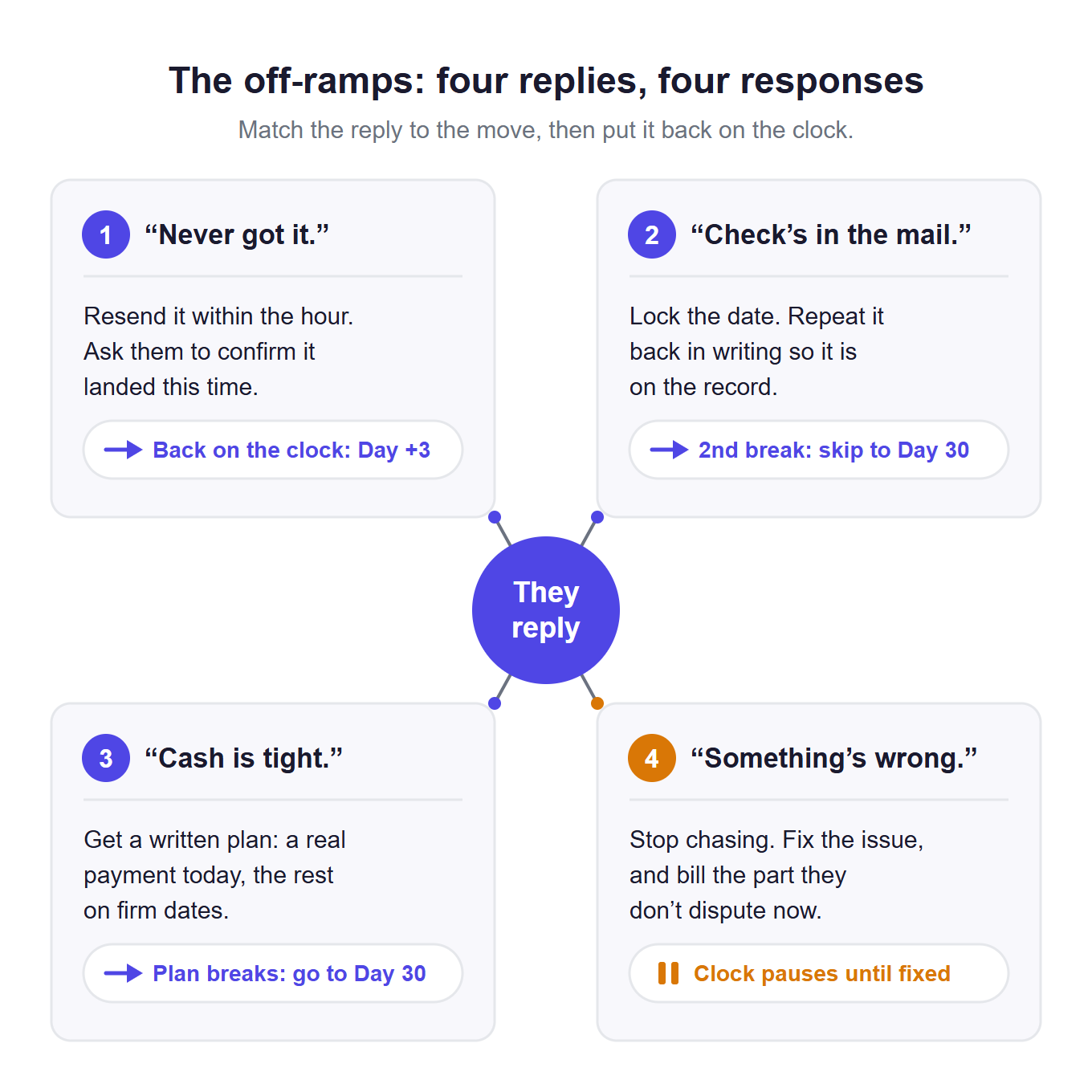
And a reply, whatever it says, changes the game. The clock is built for silence. The moment a client talks, you leave the schedule and take an off-ramp. There are four, and each one re-enters the clock at a specific stop.
Off-ramp 1: "We never got it"
Plausible at day 3. Suspicious at day 40, when two earlier reminders went somewhere. The response is the same either way. Resend within the hour, to an address they confirm on the spot, and ask for a same-day reply confirming it arrived. Then re-enter the clock at Day +3, not Day 0. The work was delivered and the due date passed. Their inbox eating the invoice does not move that date, and restarting from zero would teach every client that "never got it" buys a free month.
Off-ramp 2: "The check's in the mail"
A dated promise is the best reply on this list, so take it gracefully. Then lock it in with the repeat-back: "I'll note the 12th and check in that afternoon if it hasn't arrived." Saying the date back turns a soothing noise into a commitment on the record. Put it in the same email thread, too, so the whole story lives in one place.
If the date passes unpaid, the promise rule from stop 5 applies: the first break gets one grace, a same-day follow-up with no lecture. A second broken promise skips the clock straight to Day 30. Promises are currency. Pass a counterfeit twice and the clock stops accepting them.
Off-ramp 3: "Cash is tight right now"
This is the reply that deserves real empathy, because can't-pay and won't-pay are different problems that sound identical from your side of the table. It is also the one where you can feel anger and sympathy about the same invoice, sometimes in the same hour. That is normal. Journalist Anna Codrea-Rado, chasing her own overdue invoices through a downturn, nearly cried on one of the calls. Her public account of it lands on a method you can borrow. Open with empathy and ask the client to explain what is going on, then use the answer to separate genuine cash trouble from stalling. And pick your battles by size: she chased her biggest invoices first, because you only have so much fight in you.
Empathy first, then structure. Offer a written plan: a real first payment this week, a third or half of the balance, then fixed dates for the rest, all confirmed by email. A partial payment today beats a full payment that never arrives, and a client who makes that first installment has just shown you they are a can't-pay, not a won't-pay. One tactical note: the subject line for this client is "Payment options for invoice #1042." A person who is avoiding you will not open another reminder. They will open options.
Off-ramp 4: "There's a problem with the invoice"
Stop chasing. Today. A dispute chased like a debt becomes two losses at once: the client and the money. Ask exactly what is wrong, then fix the fixable fast. A wrong PO number is a ten-minute repair; a scope argument is a conversation, and you should have it this week, not at day 60. If the dispute covers only part of the bill, collect the undisputed part now, on a separate invoice if needed. The disputed remainder re-enters the clock the day the dispute is settled.
Most replies are not confessions, and they are not insults either. They are the machinery from earlier in this article finally engaging: the approval chain waking up, the payment run coming into view. Your invoice is still your mortgage and still their line item; the difference is that someone is now looking at the line item. The off-ramps exist so the clock never punishes a client for talking to you.
Never need this article again: the moves that prevent the chase
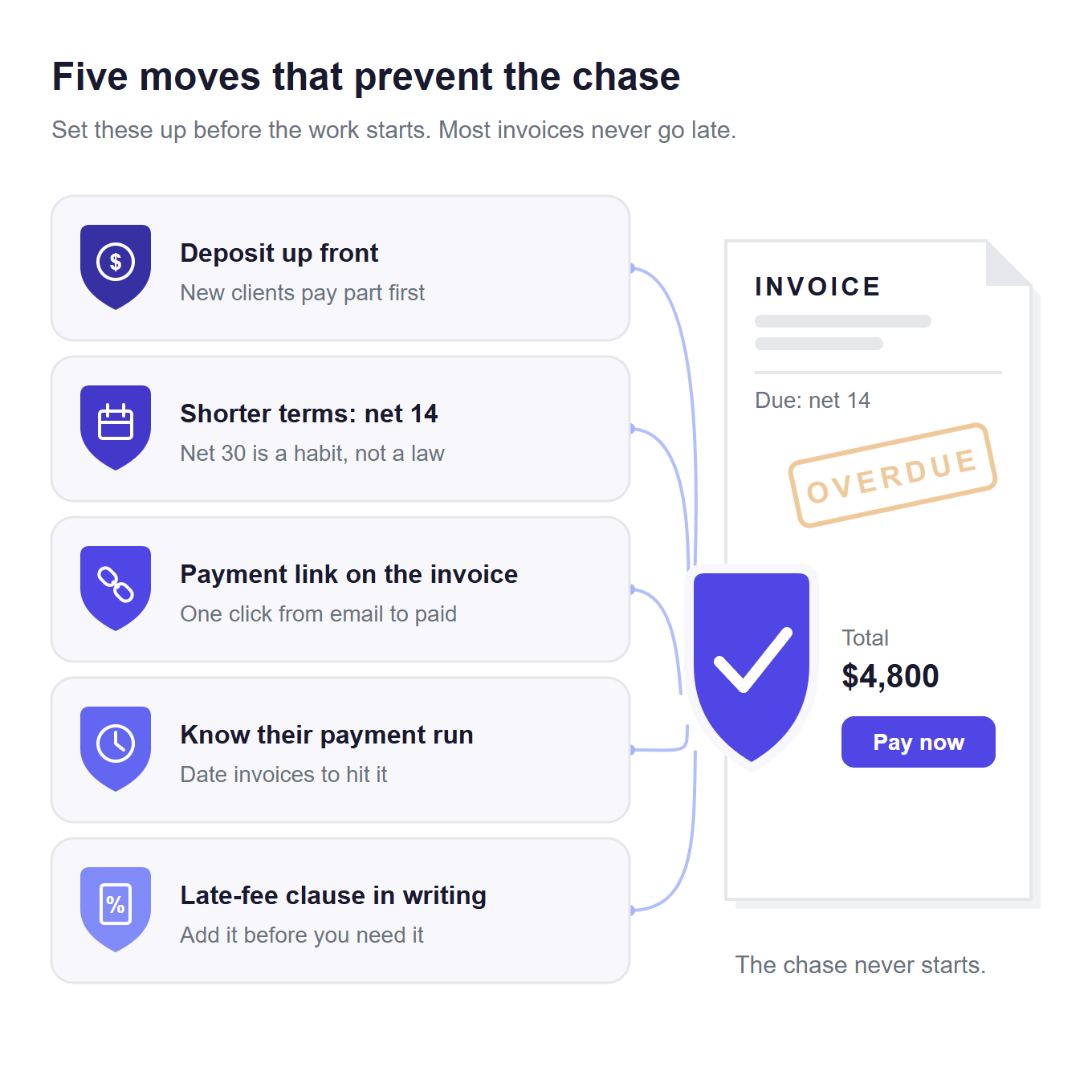
The cheapest invoice to chase is the one that never goes late. And whether an invoice goes late is mostly settled before the work starts, not after the invoice sends. Five moves do most of the settling.
1. Take a deposit up front. For new clients and big projects, get money in hand before you start. A client who has paid you once will pay you again, because the account is set up and the approval already happened. A deposit also smokes out the won't-pays while your calendar is still empty. Better to lose a bad client in week zero than in month three.
2. Shorten your terms. Net 30 is a habit, not a law. Nothing stops you from net 14, or due on receipt for small jobs. Even if clients run late by the same number of days, shorter terms pull your average collection date forward by weeks.
3. Put a payment link on every invoice. Every step between deciding to pay and actually paying loses money to friction. One click should cover the whole distance.
4. Learn each client's payment run. If their payables go out on the 25th and your invoice is due the 14th, that client will read as slow forever. One question in the pre-due email, "when does your payables run go out?", can fix a slow payer permanently. Then date the next invoice to land inside the run.
5. Fix the paperwork while nothing is on fire. Put the late-fee clause in your standard contract and the heads-up email in your standard process today. The clause you write now is the lever you will have at day 30 next time.
Two of these moves cost you something, and it would be dishonest to pretend otherwise. A deposit will scare off a few prospects, usually the exact ones you would be chasing at day 40. Net 14 will draw grumbles from big-company payables teams, and sometimes you will have to accept their 30. Neither cost is a reason to skip the move.
The evidence that process pays is soft, but it points one way. The 2025 QuickBooks late-payments report found that businesses with fewer overdue invoices had 4% to 28% higher rates of digital tool adoption. That is a correlation with a wide range, not proof of anything; read it as "businesses that get paid faster tend to run their billing on rails." The same report's sturdier numbers show the stakes. Businesses with the most overdue invoices were more than 1.4 times as likely to report cash-flow problems, and they leaned harder on borrowed money: 31% used lines of credit, against 21% of businesses with fewer overdue invoices. A late payment costs you twice, because you pay interest on the money that covers for it.
None of this has to be you, either. Chasing is repeatable work with clear rules and a fixed calendar, which makes it one of the first tasks worth taking off your own plate. Hand the clock to a bookkeeper armed with these scripts, or to software built for chasing invoices on a schedule, not when you remember. Either way, the only recurring job that stays yours is the day-14 phone call.
If you want software to run the clock: what our invoice-chasing agent actually does
Praxivara ships a template called Overdue Invoice Chaser. It's one of 20 ready-made agent templates, and it runs the same kind of clock this article describes, on your invoices, from your own email address. This is the product we disclosed at the top. It is not for everyone, so the fit test comes before the feature list.
Skip this if:
- You send fewer than a handful of invoices a month. A calendar reminder plus the scripts above will do the job, and that setup is free.
- Your invoices live in Xero or FreshBooks. Praxivara doesn't connect to either today.
- Your receivables are tangled in disputes. Software escalating a disputed invoice makes things worse, and the agent's own guardrails skip disputed accounts for exactly that reason.
For everyone else, here is what the template is built to do, stated plainly. Each weekday morning it pulls every open, unpaid invoice through the QuickBooks integration, or from Stripe, Wave, or Zoho Books. It sorts them into four age buckets: 1-7, 8-14, 15-30, and 30+ days overdue. Then it sends the rung that matches. Young invoices get a friendly nudge. The middle buckets get a firmer reminder with the statement attached. At 30+ days, a final notice goes out with the account owner copied. Everything sends from your own Gmail or Outlook, so replies land in your inbox. And every email carries the invoice number, the amount, the due date, and a payment link.
The guardrails mirror this article's own rules, which is not a coincidence. The agent never chases the same invoice twice in one week. It skips anything disputed or on a payment plan. It logs every touch to a Google Sheet and builds an ageing PDF showing which invoices are how old. Each run also sends you one SMS or WhatsApp roll-up: what was chased, what got paid overnight, and which accounts now need a human phone call. That last item is deliberate. The day-14 call stays yours. The agent flags it; it doesn't dial.
One thing the agent never does is collect money. It sends reminders and payment links, then reconciles what comes in — it never charges anyone.
On control: the big decisions happen at build time, where they belong. You choose whether the agent checks with you by message before it acts or runs on its own, and you connect each integration yourself. New skills are proposed with an install card, never added silently. Some limits sit on the server, beyond anything the AI decides it wants: an agent can only call tools it was explicitly granted. If you're evaluating any tool in this category, ours included, run it through the seven security questions to ask any AI vendor first.
On cost: a run spends credits based on actual AI usage, roughly the cost of compute times a margin. There's no per-seat or per-email fee. What a month costs depends on how many invoices you're chasing, so any flat number quoted here would be a guess dressed up as a price. The mechanics are in how credits are spent.
One last note. Everything above describes what the template is built to do, not what it has survived. The advice from the clock section still stands: run it by hand at least once before you hand it over. You'll know what a good chase looks like, and you'll know from the first roll-up whether the agent is running yours the same way.
Quick answers on chasing overdue invoices
How long should you wait before chasing an unpaid invoice?
Don't wait. Send a heads-up a week before the due date and the first nudge three days after it. Xero's ledger data on US small businesses shows the average invoice gets paid 9 days late, which means early silence is usually normal accounts-payable machinery, not a snub. That is the whole argument for starting the chase as routine process, before the invoice is old enough to feel personal. Stops 1 and 3 of the Escalation Clock carry the exact wording.
How many payment reminders should you send before escalating?
Four emails and one phone call across the first 30 days. After that you stop counting reminders and start naming consequences, from the day-30 final notice through the day-90 decision.
The count is a default, not a rule. The exits matter more. A second broken promise means skip straight to the final notice. A bounced email or a dissolved company means jump to day 60. You escalate because the clock says so, not because you finally got angry.
What should a final notice actually say?
Four things. The facts in one line: invoice number, amount, due date, and days overdue. The paper trail in a second line, listing what you already sent. A named next step with a real date, and only a step you will genuinely take. And one exit: payment by a set date stops everything right here. Copy the account owner, not just your day-to-day contact. No adjectives, no threats you won't keep. The full wording sits at stop 6, in the day-30 section above.
Can you take a client to small claims court over an unpaid invoice?
Generally yes, and you don't need a lawyer. Small claims court exists for exactly this, as long as the debt sits under your state's limit. Limits and filing steps vary a lot by state, so check your own state's rules before you count on this route.
Budget real hours for the paperwork and the hearing, and bring the whole paper trail. Then know the catch: winning a judgment and collecting the money are two different problems. A client who ignored eight messages can ignore a judgment too. Stop 8 walks through the math of whether filing is worth it at all.
The short version
Chasing an overdue invoice is operations, not confrontation. You are not asking a favor; you are running accounts receivable, the same way you run payroll. So run it on rails. Put the eight stops of the Escalation Clock on your calendar and send the scripts as written. Take the off-ramp the moment the client talks. At day 90, let the math decide, not your pride. None of it depends on how brave you feel on a given Tuesday.
The heads-up email for your biggest open invoice takes about four minutes. Send it today.
If you'd rather hand the clock to software, build the Overdue Invoice Chaser from a ready-made template and let it send the reminders while you keep the phone calls. Or just copy the scripts above and run the whole thing by hand. Both outcomes are fine with us. See how Praxivara agents work.